

The settlement signoff window
On settlement-sensitive infrastructure projects, the time between placing preload or surcharge and confirming the soil has settled to the required extent is a known cause of program delay. It can't be shortened by working faster. It can only be shortened by knowing earlier, with confidence, when specifications are met and it's safe to proceed.
It's in this window that monitoring decisions really matter.
Where time is lost
The settlement window has three time-bound components:
- The soil settling. The actual time it takes for the soil to consolidate. Tied to soil type, drainage, surcharge load, and other factors.
- Data availability. The time between the soil reaching stability and monitoring data being available to check. Driven by measurement frequency.
- Data validation. The time between data being captured and reviewed, and the team being confident in the result. Driven by validation method and resources.

Only the first component is fixed by the physical behaviour of the soil. Data frequency and validation are both flexible, yet together they can account for weeks or months of schedule delay.
Most of what's happening in the soil between measurements stays invisible to the team. So how do we determine sooner when the soil has actually consolidated and is safe to build on?
The standard approach
The standard approach to settlement monitoring is bi-weekly or monthly surveys. Surveyors on the ground measure settlement plates and reference markers to build up a trend picture over time. This approach has both strengths and limitations.
The strengths:
- Defensible measurement
- Peer-reviewable data
- A documented record of consolidation and trends
The limitations:
- Insufficient data points to confidently assess a period of up to six months
- Surveyors need to access the corridor each time, often through active
construction zones with safety exposure - Validation lag. The team needs to see a pattern over consecutive surveys to
validate settlement
When observing settlement trends, we are assessing a process that reveals itself when plotted against log time or the square root of time. In practical terms, the more time that has elapsed since settlement started, the longer it takes to confidently interpret an unexpected trend in the data. But if teams can remotely access high quality, validated data each day, they can assess and analyse unexpected trends in real-time.
Without this capability, validation lag can cause the project to sit in the settlement window for a month or more after the ground is suitable for preload or surcharge removal.
What changes with continuous monitoring and what stays the same
Continuous GNSS monitoring addresses the first two issues with the standard approach. It can give you:
- Daily data points accurate to the millimetre. Trends are detected in days, not
weeks. - Improved safety. Manual visits become exceptions, removing people from
hazardous sites.
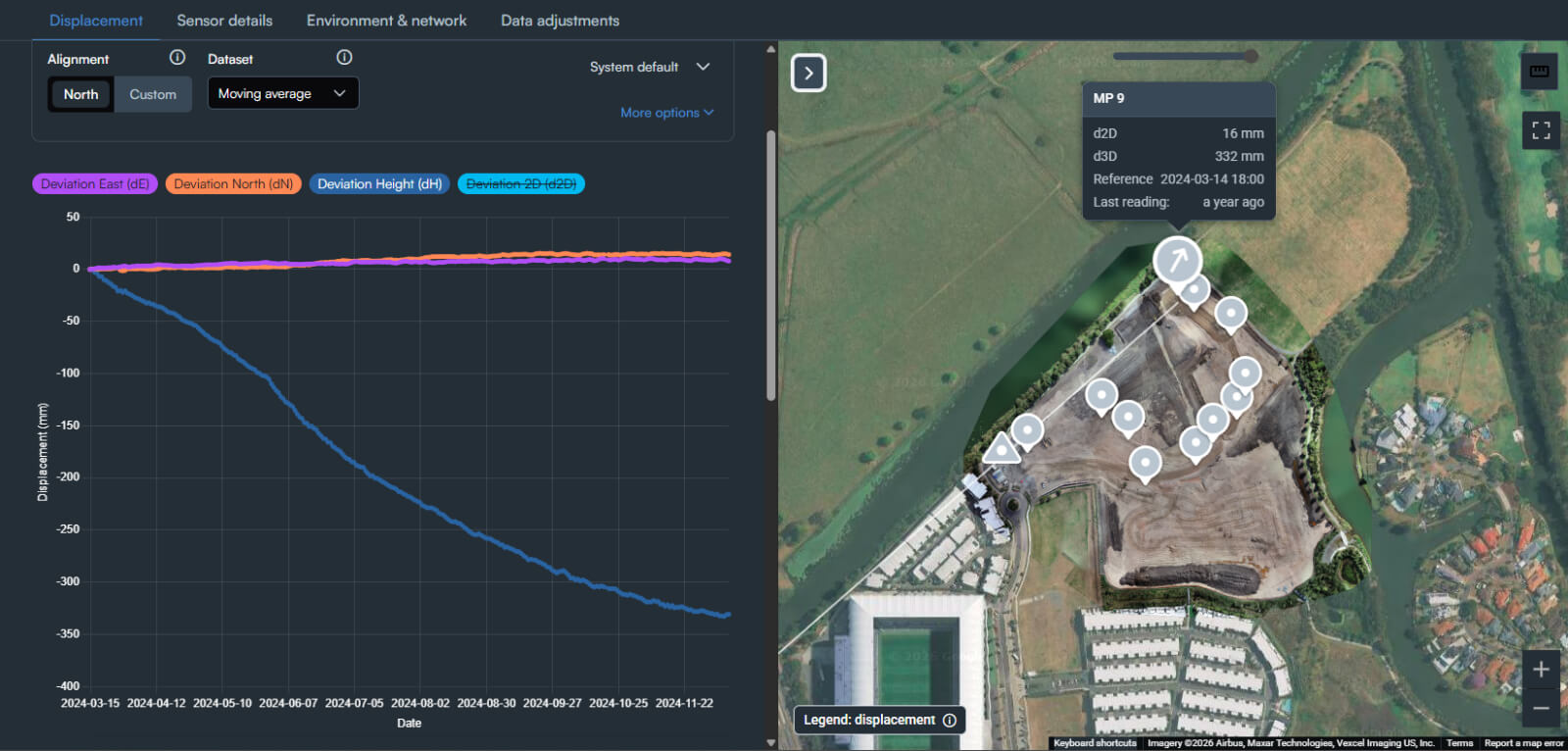
These benefits are what most teams think of when they talk about real-time monitoring. It's a meaningful improvement in these two areas. But it doesn't solve the validation time lag. Raw data still needs to be interpreted, quality-checked, and verified by the onsite team before it can support a sign-off decision.
This is the gap most real-time systems leave open. Data is delivered faster, but the responsibility for extracting a defensible trend still sits with the onsite team.
Why the validation timing matters for signoff
Settlement signoff isn't just a measurement decision. It's a defensibility decision as well. The team needs to know they can demonstrate to regulators and asset owners that the soil is settled and it's safe to proceed in a way that stands up to future scrutiny.
That requires more than monitoring data. It needs:
- Continuous independent validation. Data that's been quality-checked, processed against known reference points, and independently validated.
- An audit trail. A record of what was measured, when, and how, preserved for possible review months or years later.
- Confidence at the time of decision. Reliable, geodetically validated data the team can act on quickly, knowing they can defend it later.
When this validation layer is built into the monitoring system, rather than left to the project team, the third time component compresses dramatically. Sign-off can happen when the soil is ready, because the data is validated and defensible within minutes of the reading. The team approving the removal knows how the settlement is progressing at any given point in time. They can see the removal decision coming and can be ready to make it.
The dimensions of payoff
When your monitoring addresses all three time-bound components of settlement signoff, the gains compound across:
- Schedule. Signoff can come weeks or months earlier than under standard approaches, returning the project to its critical path and improving cost certainty
- Labour. Survey effort moves from continuous to exception-based. The onsite team spends less time managing the data, freeing skilled time.
- Safety. Time spent in active construction zones drops, reducing exposure for everyone involved.
- Defensibility. A continuous, validated data record stands up to peer review and regulatory scrutiny in a way either manual survey or raw GNSS data can't match. If a result is questioned later, the data and validation methodology are preserved and easy to access.

The underlying principle
The shift isn't just a hardware or methodology improvement. It's a change in what monitoring is for.
Under the standard approach, monitoring confirms what happened after the fact. Continuous monitoring shows movement as it’s happening. Proactive, defensible monitoring actively supports decisions while they're being made, without transferring responsibility to the team that needs to act on the data.
That last shift is the one that closes the signoff gap. Real-time data is necessary but not sufficient. When independent specialists proactively manage the integrity of your data, signoff can happen the moment the soil is ready rather than weeks later.
What defensible data looks like in practice
Many real-time systems apply heavy statistical averaging at the point of measurement to smooth out noise. The data looks clean, but can mask centimetres of underlying uncertainty. A statistically averaged result at capture can delay the time it takes to make a decision and doesn’t remain independently defensible over time.

Defensible, continuous GNSS monitoring with managed data integrity is what Kurloo was built to deliver. We provide millimetre-accurate GNSS readings with independent geodetic validation handled centrally, so the data is already defensible by the time it reaches the project team. The raw GNSS observations remain available for deeper analysis and review at any time, so the onsite team retains full control and peace of mind.
We’ve worked across infrastructure projects where a proactive monitoring approach has significantly compressed the signoff window and resulted in measurable gains. We'll share an example in detail in our next update.
In the meantime, if you're considering whether there are gaps in your civil infrastructure monitoring ecosystem, you might find these links useful:
- Find out more about GNSS for geomonitoring: The technical foundations of how GNSS measurement works in monitoring contexts
- Monitoring methods compared: Where different methods work well in a high-consequence monitoring ecosystem
- Book a consultation to discuss what proactive monitoring would look like on your specific project